

By Ian Tingen
In writing my piece about autopolitical asphyxiation, there was one snippet I couldn’t quite fit in. I’ve put it here lest it become another draft lost to the archive.
Have you ever heard that axiom “Never attribute to malice what can be attributed to ignorance”? It is the core sentiment of smugness, liberal or otherwise. Calling something ignorant dogwhistles elitism. You might as well say “look at these poor rubes, undecuated rabble / racists / Trump supporters that they are”. It automatically sets up a power imbalance: our educated civility vs. their uneducated chaos, our wordly view vs. their visceral reactivity. It’s an elegant ad hominem wrapped in a folksy tsk tsk. (Editor’s note: yes, folksy has been used purposefully.)
TL;DR: Calling someone ignorant reduces them to an imbecile, a lesser being defined solely by their lack of experience and knowing.
Why’s this matter?
For those of us on the social left, it makes us guilty of the reductionism we rebuke in our pursuit of advocacy in identity politics. More broadly, it allows us to privilege personal ways of knowing, feeling, and thinking above all. Then, there’s the bonus that calling someone ignorant is understood to focus only on knowledge – not feelings, thoughts, or logic. We get to be whole beings; they do not.
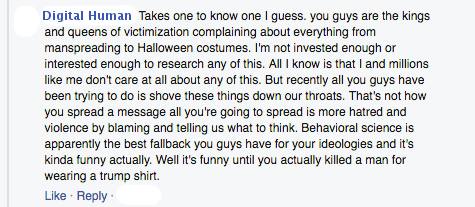
“Never attribute to malice what can be attributed to suffering.”
Knowledge is important. It’s a grand equalizer. As the sole metric for worthwhile human engagement, it sucks. We need to think much more broadly about those we consider ignorant and malicious. We need to allow them the breadth of expression we allow ourselves and those we advocate for.
We can do better.
 Intersection 9