
by Ian Tingen
Originally published 11/15/2021, updated on 10/03/2025
If you’ve known me for any amount of time, you know that I *love* social science. Post Ph.D. training, I founded a company on the principle that social science can ask and answer the most important questions facing individuals, societies, and businesses.
My love is complicated, sometimes: like when Harvard professor Dr. Amy Cuddy disdainfully retweeted one of my core beliefs. I believe the best science is gladiatorial.
(Hi, Ian from 2025 here. Cuddy’s twitter account is gone, but Wayback Machine screencaps are at the end of this article for more context.)
Soon after the retweet, my phone’s notifications lit up. One early recurring theme was that ‘violent’ words like gladiatorial made some social scientists uncomfortable. Others said that such language was keeping important voices out of social -and open science; that it was exclusionary.
I can accept that argument at face value. But it, like any argument worth considering, spawned more questions:
1) what kinds of people are we keeping out of science by policing language like this?
2) what does that say about the science community’s biases?
I know that *not seeing enough violence* cost me and another person our jobs, once.
In fact, it was my first paid psychology lab job!
My task was to code parent-child dyads (on VHS tapes!) for different expressed emotions. Our coding group consisted of four undergraduate students. We trained for weeks, refining consensus on the coding structure. And then, blinded to the hypotheses of the work, we began.
After a week, our group’s inter-rater reliability was ~ 0.60. Ideally, you’re looking for IRR to be above 0.80.
We took a week to recalibrate. New IRR: ~0.62. The PI, visibly vexed, also shared that there were two pairs within the coders who had IRR higher than 0.80! How ironically preposterous!
Soon after, I was fired from the project, as was another coder. I needed to know *why*. As far as I knew, I had done nothing *wrong*.
I will fully cop to HARKing, here, but this is the fact pattern I uncovered:
1) The coders that were fired were one of the high IRR dyads
2) The coders fired came from lower-income families-of-origin in the American south (NC and GA)
3) The coders that were fired rated parents as less aggressive, less negative, and less loud than the coders that stayed on
4) The coders that stayed on and the PI shared a ‘WASP’-y, non-southern, affluent background
5) The parent-child interactions were recorded in Virginia, and consisted of self-reported white and black people
I concluded: Two southerners got fired from a study, likely because their interpretation of emotional and vocal data did not culturally align with the PI and other coders.
Where we saw normalcy, others saw violence.
And thus,we lost our jobs because our backgrounds were a problem, not a source of relevant context or richness. Censure, for a lack of cultural conformity.
Which brings me back to the present.
Honest inclusion is a tricky beast. It requires those with power to value the existence and experience of people far afield from the seat of leadership.
Whether or not ‘combative’ perspectives are ‘well’ or ‘over’ represented in Open Science is a *highly* subjective judgment that relies on a panoply of assumptions about rhetoric, gender, culture, and power.
Such heuristics might seem logical from 30,000 feet up, but are often grossly inadequate for interpreting the smaller contexts that academic culture exists in. Where we draw the line between appropriate vs. abrasive vs. abusive discourse is as much a function of cultural and epistemological self-selection as it is the perceived terseness of a Tweet.
Power doesn’t breathe the same in rarified air, especially for those judged as not belonging there. If your sense of being on the right side of history stems from who you’re allowing to breathe those noble gases, you’re probably doing it wrong!
EDIT: October 3, 2025
Thanks to the reader that notified me Cuddy’s account had been deleted. I went to the Wayback Machine and grabbed these screencaps that should help give context. I cannot find a way to capture Cuddy’s original response to me, but my original tweet is still up as of this edit.

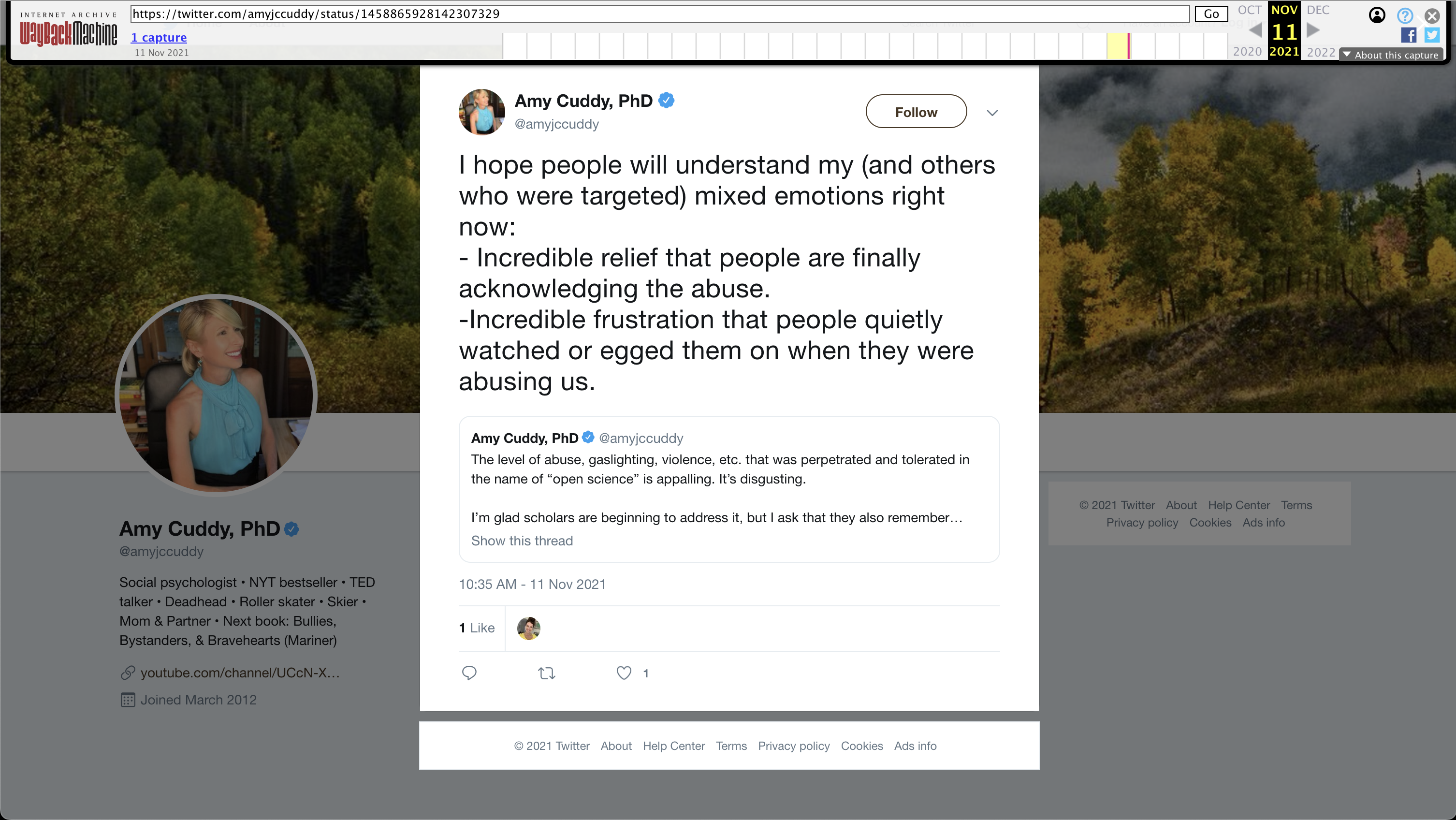
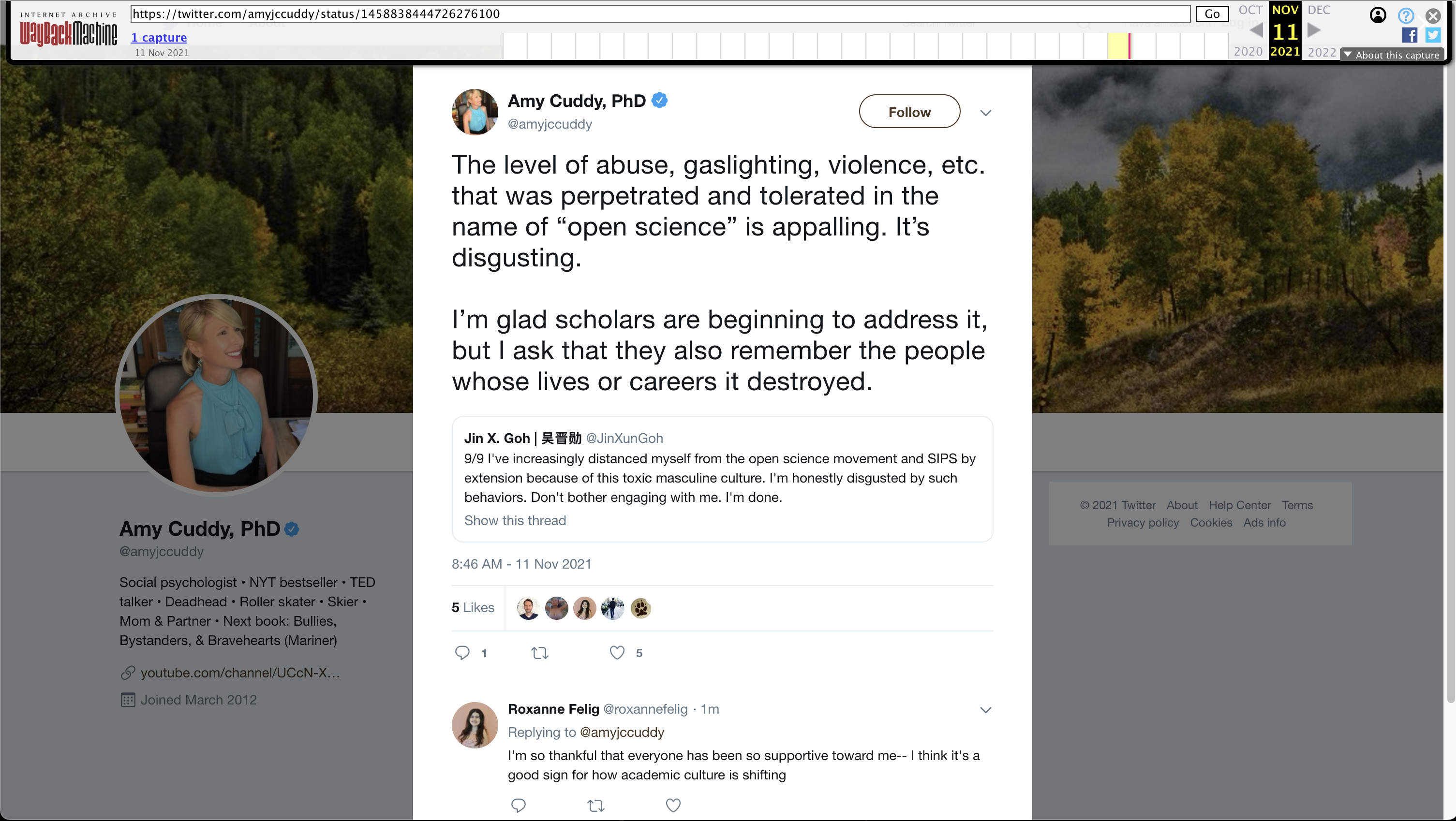
and just to be double-safe, links for the above:
https://web.archive.org/web/20211112211650/https://www.twitter.com/thisisiwt/status/1459268938978586626
https://web.archive.org/web/20211111183624/https://twitter.com/amyjccuddy/status/1458865928142307329
https://web.archive.org/web/20211111165027/https://twitter.com/amyjccuddy/status/1458838444726276100
 Intersection 9